The purpose of this organisation was clear,it stood for everything that we stood for. Even though our practices involve advocacy and policy,we always strive to raise awareness.
Our Organisation stands for everyone and anybody who wishes to change things.
Our newest campaign has been established for supporting females,essentially Brown Women.
Brown and Female is a Brown Woman Sisterhood with the motto of being Empowered Together. This sisterhood does not possess any cultural barriers among Brown Women throughout the world and encourages them to develop a system of networking to support each other and their own causes whilst providing a platform to do so. The purpose behind Brown and Female is to develop a Brown Women Community worldwide and to deal with their problems whether personal or political,together. To reach out to people in need of help who would understand us better. .
This Sisterhood is for Brown Women of all ages and culture to mix with people alike,for them to know that through this platform they will be able to garner support irrespective of what they are dealing with. The community we hope to build and strive for is a Sisterhood that builds and empowers Brown Women so that our voices cannot be curbed anymore. The agendas of this Sisterhood make up of our own personal struggles we face in our lives almost daily and also with the ones that shackle our race as a whole. The vision for this Sisterhood is simple,it is personal,political and whatever us,Brown Women want it to be.
Brown and Female intends to mobilize The Brown Women Community and provides them with a safe space to voice out their concerns,opinions and rights. Each one of us gets to be the leader and the campaigner in our own cause whilst helping other causes and people. Our Sisterhood would stand for everything that we want to grow it into.
We would request all the Brown Women out their to come together and empower themselves by representing a strong Community.
Brown Women worldwide are welcome to join us in our fight to be counted as equals.
You can join us on our Instagram page with the username brownandfemale.
Rape has been considered to be an act usually committed against one sex and the laws in India certainly tilt towards woman rather than protecting every citizen and gender.
Despite expanding the definition of rape under the Indian Penal Code to include non-penile vaginal acts of penetration, the said definition continues to conform to a gender-specific notion of rape, based on a predetermined characterization of the victim-perpetrator framework on the basis of genders. Implicating a binary notion of gender, this results in gross injustice and it therefore, becomes imperative to adopt a human-rights-based approach in defining the offence of rape, and negate the role of gender in identifying the victims and perpetrators of an act of rape, and establish equity. This argument may be pillared on a state’s obligation to not discriminate on the basis of sex, the recognition of transgender rights, and an assessment of the common grounds for opposing gender neutrality in Indian rape laws.It can be said that crimes against women in India have a lot to do with centuries of patriarchy and a skewed sex ratio. However, the perpetrators often enjoy impunity at the risk of women’s rights and security.
In 2013, one of the most brutal and fatal gang rapes in New Delhi led to not only massive and supremely angry nation-wide protests, but also led to landmark reforms to the existing rape laws. By taking into account the gender and patriarchal attitudes in Indian society, the new laws reform changed the landscape of justice for women by taking a tough stand on crimes against women. In the aftermath of the Nirbhaya gang-rape and death, the Justice Verma Committee was formed in 2013 to review sexual offence laws. As a consequence, Indian women can now file a rape charge online. Cops are duty bound to register a case immediately upon complaint. Rape remains the fourth most common crime against Indian women so these changes were necessary, and critical.To see the crime as merely a man violating a woman, as it currently is currently being seen, however, is an injustice to those whose story does not fit this ambit. There is thus, still a great need for further change to India’s rape laws.
On the same idea, a private members’ bill has been introduced before the Rajya Sabha. This bill would introduce amendments in the criminal laws to make sexual offences gender neutral. Re framed language in sexual offence laws would aim to change ‘any man’ and ‘any woman’ to ‘any person’ – a step forward to make the laws gender neutral. “Men, women, and other genders can be perpetrators and also victims of these offences. Men, women and others need to be protected”.
In understanding the need for this change being pitched, one must first understand what exactly constitutes rape. International law has evolved from viewing it just as penile-vaginal to penile-orifice and then to penetrative-orifice, all within a non-consensual context. By the last legal definition, the physical violation with blunt objects undergone by Nirbhaya at the hands of her gang rapists would be classified as rape.It would by current Indian legal standards as well. Yet, for instance, if there were to be such an act committed by a woman against a man or even another woman, it would not amount to rape. To be sure, it would be an assault-based crime of some form, but not rape. This, even though the victim would have been forcefully penetrated in a sexual manner by her assailants.The same result would also come about if the victim were a child, as the law would allow for a charge of sexual assault, but not one of penetrative sexual assault, which is codified as male-only. Many parliamentarians and some activists argue that only members of one sex can rape and only the other can be raped, for rape is only ever patriarchal. The Indian laws are thus very limited in this regard, bringing to light this shortcoming. Statistically with regards to the existence of both male and female survivors, the US’s Centers for Disease Control in Atlanta has estimated that 18.3% of American women and 1.4% of American men have experienced rape at some point in their lives. Both percentages are likely to be underestimations due to stigma attached to reporting the crime. Ideally, India would be able to provide its own numbers for statistical comparison.
However, given that rape by legal definition cannot be committed against men, there is no good way of determining just how many male survivors exist in India.Considering the argument that equity in a society is cardinal to its good governance, in addition to those discussed above, such a change and broadening of the definition of rape under Indian laws may also be deemed essential. What also need to be considered is that even though women suffer from such crimes in incomparable numbers, the law cannot turn a blind eye to the victims or the perpetrators of other genders.
In conclusion, the impulse to view the rape narrative as exclusively that of a man violating a woman does an injustice to those whose dismal stories and sufferings simply do not fit the mold that is easiest for us to understand and therefore,an imperative need to redefine norms of the society is felt which would help only if the laws are not made to favor any gender rather to determine the acts that constitute this heinous crime which could be committed against any person.
As a law student I am supposed to write about advocacy and policy. While I believe it to be helpful in my professional life,I also believe that my Co-founder and I created this blog for it to help debate and talk about everything that is wrong with our Indian system and society,especially when people claim it to be in the name of religion.
While I contemplated a lot before writing this article and thinking what good will my article do,I remembered the sole reason for us to come together and put together our entire act into an organisation was to stand up for the things that we believe in.
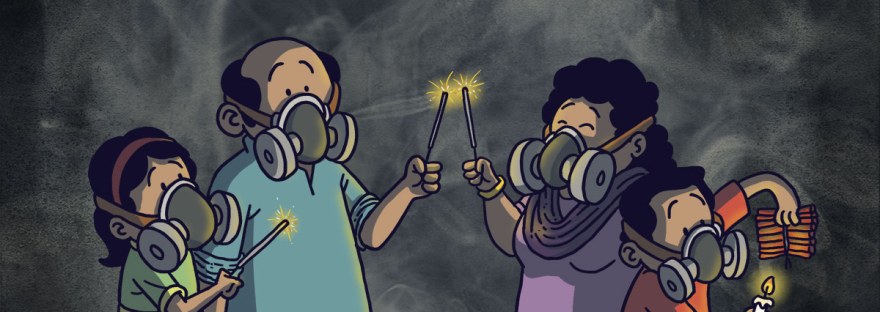
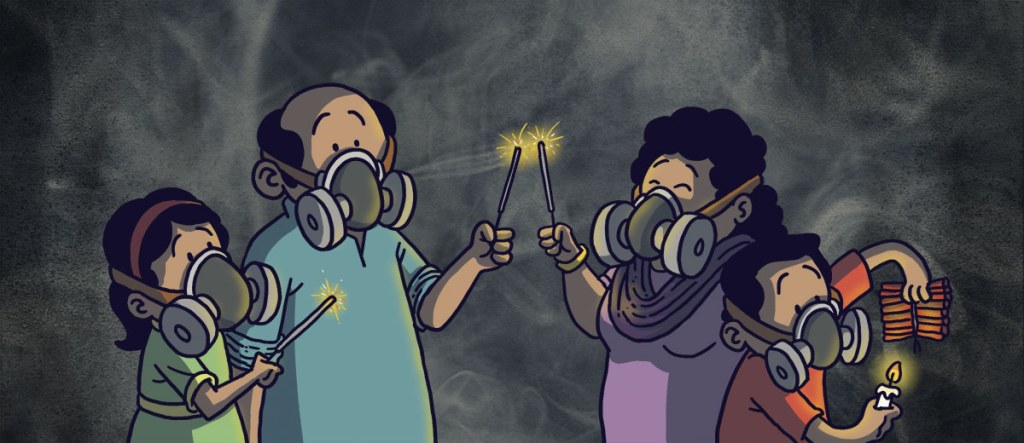
Our festivals of lights,Diwali just passed. This festival used to be my favourite festival since I was a kid but the reason why I loved it the most soon became the reason I have started to hate it. A custom of wearing new clothes,praying to our Gods and then the part I could barely wait for every time this festival arrived,the part where we burnt crackers.
Burning crackers used to be a tradition at my house,everyone used to gather round and celebrate the festival of lights. But the reason why I adored this festival this year became the hazard that I could never fathom for it to be.
Why is this relevant for me to write about?
This is relevant because people across the city of Delhi-NCR have come up with excuses to justify their actions.
Everyone was and is aware that the air breathed in these four cities is deemed to be hazardous. And let me elucidate that anything above 100 appearing on your Air Quality Index that you have been checking out since Diwali to decide whether to step out of the house or to let your child play in the park is considered to be unhealthy.
The justifications that I heard for bursting some of the “green crackers” and a whole lot regular crackers were that it is a custom to burn crackers during Diwali and “oh,why do you no say anything to anyone when they burst crackers during New Years and Christmas.”
Among others there were also some who tried to blame everything else from the public transport system to “What will happen to the manufacturers who produce these crackers?”
Lets answer these questions one by one. Firsty all those people advocating for green crackers and claiming that they cause less harm to the air apparently,are you aware how these crackers are regulated and if they are at all regulated? Let me help you,they aren’t regulated and there is no regulation which is about to be imposed either,and judging by this country’s legislation,please don’t hold your breath.
The ones claiming that Indians burst crackers on New Years and Christmas and why don’t I put out posts blaming those people.
Well,for me this is not shifting of blame but realising that crackers are harming our already severely polluted air and if you’re asking me to blame every American,British et cetera citizen throughout the world,have a good look because their air is not as polluted as ours.
What stunned me the most when people were advocating this argument was how bizarre this argument was and how essentially well law students thought this argument was. This is exactly what we are taught in law school not to do. This is similar to claiming that because the other person committed a crime and got away with it that is essentially why you did it in the first place.
And even after arguing with “these” people that it was not about any other festivals or any other country doing it but about our nation and how we should not do something which would probably put our entire family at risk and worsen the air that we have no choice but to breathe,they still failed to understand anything at all.
To the people who blamed all the stubble burning after Mister Arvind Kejriwal pleaded the farmers to stop seemed a complete way out for them.
PS:The Government also pleaded you not to burst crackers. 🙂
Let me realistically put this problem to a test by saying that that night of Diwali everyone acted like farmers burning stubble at the same time(which is unlikely because every farmer throughout every state is not likely to burn their stubble every day,hence,the pollution that they were causing over some months you caused that in a day) which caused the Air Quality Index to dip down to 600 which is downright hazardous and also made me witness my little brother having problems breathing and vomiting because of the air quality. My brother is ten years old and I am sure that half of the people who burst crackers that night were among the ones who probably have small children around the age of my brother,let me just tell you that the iota of happiness that you gave your child that night by burning crackers that night for “just their sake” is completely not worth the amount of problems that you caused him/her in the long run and it sure as hell is not your right to make other people’s children,people who were careful and considerate and who witnessed their kid having respiratory problems at a very young age.
To everyone who says that that was just one night of fun and relaxation,you all certainly did contribute to something big,dipping the air quality index to 600 and jeopardizing the lives of everyone living in the city,making the cities of Delhi and NCR a worldwide headline for people across the Globe to never want to visit the city.
Something funny that I had seen was the reaction of Indian people over a twitter thread of how Indian people in New Jersey had celebrated Diwali where they left tons of waste on the road. Ironically,Indians living in India were more disgraced with that while being in denial about the massacre of this polluted air that they caused and everyone is breathing today.
This article addresses the pertinent issues of data privacy laws in our country. The only data privacy or data protection laws that are in force in India are by the two acts- Information Technology Act,2000 and Information Technology (Reasonable Security Practices And Procedures And Sensitive Personal Data Or Information) Rules, 2011 which are deemed to be completely inadequate in this day and age.
Legislation
There are two legislations which are supposed to protect the Indian population from their data being exploited and these legislations are certainly and severely backward and incompetent especially within this age where new technology spurs the next moment almost instantaneously.
The Government even though has started to demand biometric for essential public documents such as the Aadhar card,they fail to recognize how loosely encrypted their own websites are which can easily be exploited for the data they store.
The Government further on has introduced a requirement to link Aadhar Cards to be linked with a person’s PAN card which again is a big massacre waiting to happen,as the PAN card is a source which holds all your sensitive data such as your bank account details
.
They have failed to comprehend essentially how incompetent their electronic administration system is and how miserbaly they would fail at an attempt towards digitalization unless they dont regulate the data privacy laws in this country.
Another attempt that they seem to be experimenting on apparently for the safety and security for their own people is with varied facial recognition systems. While the companies dealing with such technology deem it to be essential and are completely ecstatic about such progress,the technology used by these companies is amateurish and does not deal with the problems at hand by providing an apt solution.
It is imperative to understand that the usage of this method does not only depend upon how effective the technology is,it is important to consider that a country which is majorly corruption ridden because of their own public authorities can only be efficaciously used if its disposal is equitable which seems to be the biggest question posed.
For instance one of the methodologies that the Government wishes to adopt is to deploy this technology for the benefit of the Indian Police System.
The Police is often seemed to be an authoritative figure used only as an intimidation tool rather than as a force for the protection of the people.
The Indian police system is deemed to be heavily corrupted and filled with inadequacies such as biases against minorities,brutality against people and is also often criticised for misuse of power,hence,by allowing such a dysfunctional system to take control of such a technology would definitely call for speculation of breaching fundamental rights of people.
It is also unclear as to how this technology is to work as evidence within a court of law and how would especially minorities who make up for 55% of the undertrials in India refute such a system.
The newly emerging E-commerce market.
While the e-commerce markets promotes accessibility,convenience,affordability and healthy competition it also ensures to give a lot of leeway to companies to get away with unfair tactics.
There are several companies which demand data accessibility before letting the user use their services.
While this data is routed to third party companies to customise advertising on your device it also entails abiding by no protection whatsoever and especially in the case of body corporates not registered within India as the aforementioned rules lay down that Indian body corporates are the only ones which need to comply with such rules and regulations laid down.
The newly drafted e-commerce policy of 42 pages has heavily focused on monetizing the data received from within the economy and only a diminutive part of it talked about protecting the rights of individuals. The draft only seemed to acknowledge that it was an individual’s property and did not address the concerns as to how corporations which seem to absorb all this data are intended to be regulated. The policy draft left a lot of questions unanswered as well and seems far away from being the guiding principles that we hoped it would be.
What does the future hold?
As of February,2019 the Government has introduced a policy draft for E-Commerce marketplace and no separate bill has been introduced to regulate data which seems to be poured out to international organisations not concerned with the protection of our data as they have nothing to comply with. India being one of the biggest economies of the world with absolutely no legislation which protects it,a deficient executive system and no current legal remedies to resort to in 2019 has certainly not coped with digitalisation.
The initiatives taken by the Government of digitalising their own websites might seem to save our occasional trips to several public administration offices but does not seem to help us with protecting our privacy rights.
It further seems to be on its way of severe exploitation through bio metric systems which are to be complied with,with the help of every public authority which is feared.


 Humans for Change